Place 6 · On the Flight: Chicago ORD → New York JFK
Travel English · 여행영어 300
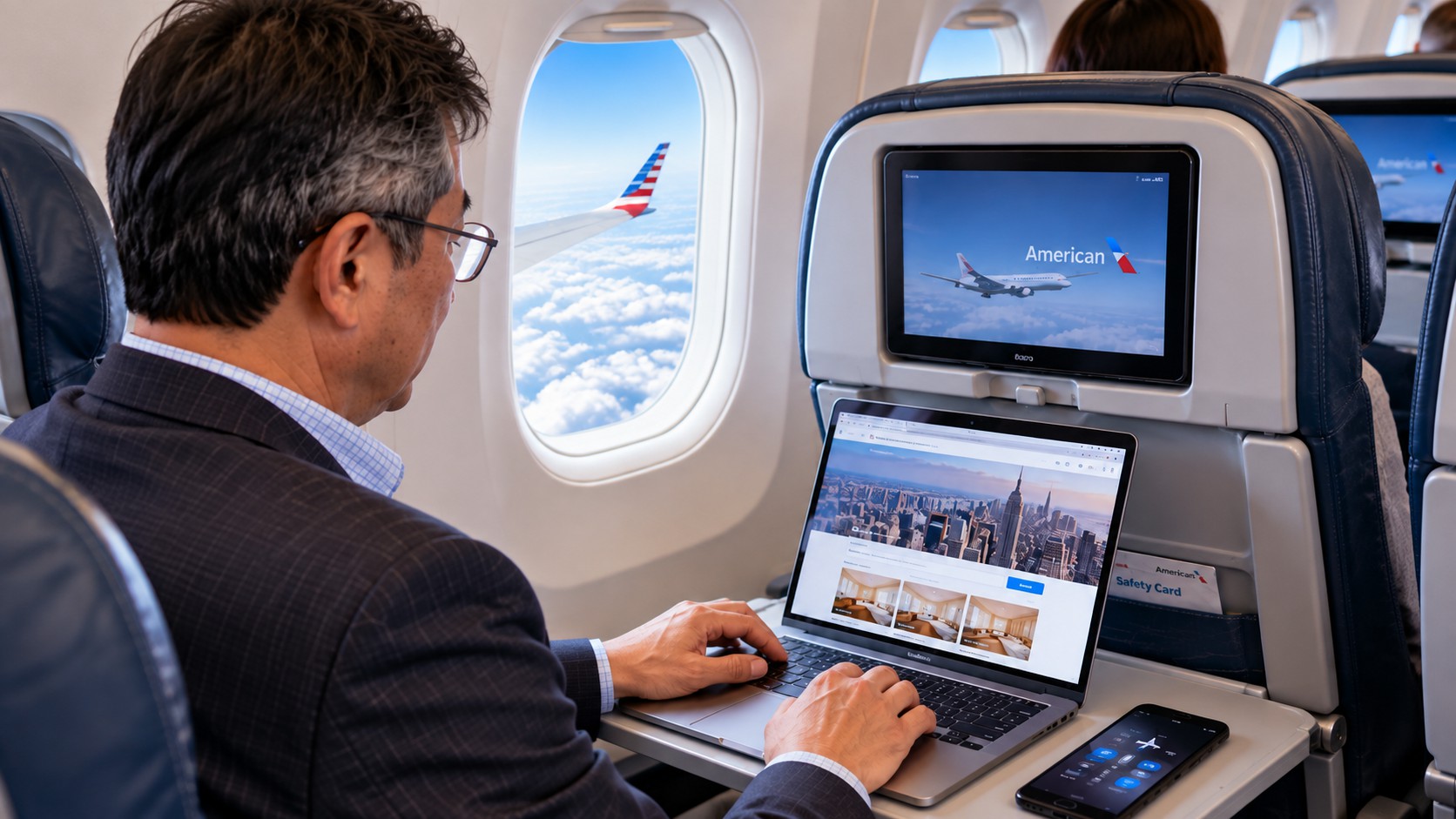
I Made It! Boarding My Rebooked Flight to New York
I made it!
I’m finally on my flight to New York.
Yesterday, I missed my connecting flight.
American Airlines arranged a hotel for me and rebooked my flight.
This is my new flight.
American Airlines Flight 2485
Chicago O’Hare to New York JFK
Departure: 1:35 PM
Arrival: 5:00 PM
Flight time: 2 hours and 25 minutes
My original flight was going to LaGuardia.
But my rebooked flight is going to JFK.
I’m in my seat now.
Today, we’re going to learn what actually happens inside an American flight from takeoff to landing.
By the time we arrive in New York, you’ll know how to handle almost any situation you may encounter on a flight.
Let’s get started.
Before Takeoff: Stowing Bags and Meeting the Flight Attendant
The flight attendant is checking the cabin before takeoff.
Flight Attendant: Excuse me, sir. Could you please put your bag under the seat in front of you?
Passenger: Sure. Is this okay?
Flight Attendant: Yes, that’s fine. Thank you.
Passenger: Excuse me. Could you help me with this bag?
Flight Attendant: Of course. Let me help you.
Passenger: Thank you.
Flight Attendant: You’re welcome.
Before takeoff, flight attendants walk through the cabin and make sure everything is ready for departure.
They check that carry-on bags are properly stowed, the aisles and exits are clear, and passengers are following the safety instructions.
Now, let’s learn an important American English term.
In the past, you may have heard the word “stewardess.”
A stewardess meant a female cabin crew member.
But today, the standard professional term is “flight attendant.”
We use “flight attendant” for both men and women.
Why did the terminology change?
Because the job is not simply serving passengers food and drinks.
A flight attendant is a trained aviation safety professional.
Their primary responsibility is passenger safety.
They are trained to respond to emergencies, evacuations, fires, turbulence, medical emergencies, and other situations that may occur during a flight.
That is why “flight attendant” is the appropriate term to use today.
If you need assistance during your flight, you can simply say, “Excuse me.”
Then make your request.
Excuse me. Could you help me with this bag?
Excuse me. Where should I put this bag?
Excuse me. Is this okay here?
One polite “Excuse me” can start almost any conversation with a flight attendant.
Next, listen carefully.
The safety announcement is about to begin.
The Safety Announcement
The boarding door is closed.
The flight attendants are preparing the cabin for departure.
A flight attendant stands in the aisle.
Then the safety announcement begins.
Flight Attendant Announcement: Ladies and gentlemen, welcome aboard. Before we depart, please direct your attention to the flight attendants as we review the safety features of this aircraft. Please make sure your seat belt is securely fastened. To fasten your seat belt, insert the metal fitting into the buckle and pull the loose end of the strap to tighten it. To release it, lift the top of the buckle. Please make sure your seat back and tray table are in their full upright and locked positions. Place your carry-on baggage in an overhead bin or completely under the seat in front of you. Please make sure the aisle and exits are clear. Please switch your portable electronic devices to airplane mode. There are emergency exits located throughout the aircraft. Please take a moment to locate the exit nearest you. Keep in mind that the nearest exit may be behind you. In the unlikely event of a loss of cabin pressure, oxygen masks will automatically drop from the compartment above you. Pull a mask toward you. Place it over your nose and mouth and breathe normally. Secure your own mask before helping others. A life vest is located under or near your seat. Please follow the flight attendants’ instructions if it becomes necessary to use it. Thank you for your attention. We hope you enjoy your flight to New York.
Passenger: There’s a lot of information in that announcement. Do I really need to understand all of it?
You do not need to memorize every sentence.
But you should understand what the safety announcement is telling you to do.
Why is this announcement made before every flight?
Because passengers need to know what to do before an emergency happens.
There may not be enough time to explain everything during an actual emergency.
The most important things to understand are:
Seat belt.
Know how to fasten and release it.
Emergency exit.
Know where your nearest exit is.
And remember:
The nearest exit may be behind you.
Oxygen mask.
If the masks drop, put your own mask on first before helping someone else.
Why?
Because you need to be able to breathe before you can safely help another person.
Life vest.
Know where it is located, but do not remove it unless instructed.
Carry-on baggage.
It must be properly stowed so it does not block the aisle or an emergency exit.
Seat back and tray table.
They must be returned to their upright and locked positions for takeoff.
Airplane mode.
Your electronic devices must be set as instructed by the crew.
One more important point:
Even if you fly often and think you already know the safety instructions, listen and look again.
Aircraft can be different.
Exit locations can be different.
Safety equipment can be different.
And your seat can be different.
So when you sit down, make this a habit:
Look for your seat belt.
Locate your nearest emergency exit.
Check the safety information card.
Then listen to the safety announcement.
That takes only a few moments, but it could be very important in an emergency.
Now the cabin is ready.
We’re about to leave the gate.
Taxi, Takeoff, and Three Useful Aviation Words
The safety demonstration is over.
The cabin is ready for departure.
The aircraft begins to move away from the gate.
Captain Announcement: Ladies and gentlemen, this is your captain speaking. We’ll be departing shortly for New York. Our flight time today will be approximately two hours and twenty-five minutes. Please remain seated with your seat belt fastened. Thank you, and enjoy the flight.
Passenger: We’re moving. Are we taking off now? Not yet. We’re taxiing to the runway.
A few minutes later, the flight attendant walks through the cabin one last time.
Flight Attendant: Sir, please make sure your seat belt is fastened.
Passenger: It is.
Flight Attendant: And please put your tray table up for takeoff.
Passenger: Oh, sure. Sorry about that.
Flight Attendant: Thank you. The aircraft reaches the runway. The engines get louder.
Passenger: Here we go. We’re about to take off. The aircraft accelerates down the runway. And we’re in the air.
There are three very useful aviation words to understand here.
taxi
When an aircraft taxis, it moves along the ground under its own power.
So when the airplane leaves the gate and moves toward the runway, it is taxiing.
The airplane has not taken off yet.
runway
The runway is the long strip of pavement used by aircraft for takeoff and landing.
take off
Take off means to leave the ground and begin flying.
So:
We’re taxiing.
We’re approaching the runway.
We’re about to take off.
We’ve taken off.
Notice another useful expression:
be about to + verb
It means something is going to happen very soon.
We’re about to take off.
The plane is about to land.
The flight attendant is about to make an announcement.
During taxi and takeoff, remain seated and follow the crew’s instructions.
Keep your seat belt fastened.
Keep the aisle clear.
Make sure your tray table and seat back are in the required positions.
Now we’re on our way to New York.
Turbulence and the Seat Belt Sign
The plane has taken off.
We continue climbing.
After a while, the aircraft reaches a higher altitude.
DING!
The Fasten Seat Belt sign turns off.
Flight Attendant Announcement: Ladies and gentlemen, the captain has turned off the Fasten Seat Belt sign. You may now move about the cabin. However, for your safety, we recommend that you keep your seat belt fastened whenever you are seated.
Passenger: The seat belt sign is off. Can I take my seat belt off now? Yes, I can. But I think I’ll keep it fastened while I’m sitting.
What does the Fasten Seat Belt sign mean?
When the sign is on, stay seated and keep your seat belt fastened.
When the sign is off, you may normally get up and move around the cabin.
But that does not mean there is no possibility of turbulence.
Turbulence can happen unexpectedly.
That is why airlines recommend keeping your seat belt fastened whenever you are seated.
A little later, the plane begins to shake.
Passenger: Oh, it’s getting a little bumpy.
DING!
The Fasten Seat Belt sign comes on again.
Captain Announcement: Ladies and gentlemen, we’re experiencing some turbulence. Please return to your seats and fasten your seat belts. We ask that you remain seated until the Fasten Seat Belt sign has been turned off. Thank you.
Passenger: The seat belt sign is back on. I’d better stay in my seat.
Let’s learn two important words.
turbulence
Turbulence is irregular air movement that can cause an aircraft to shake or move suddenly.
You may hear:
We’re experiencing some turbulence.
We’re expecting some turbulence ahead.
There may be some turbulence during the flight.
In everyday conversation, passengers often use a simpler word:
bumpy
The flight is a little bumpy.
It’s getting bumpy.
That was pretty bumpy.
Notice the difference.
turbulence is the aviation term.
bumpy describes how the flight feels.
What if you are walking to the lavatory when the seat belt sign comes on?
Follow the crew’s instructions.
If you are told to return to your seat, return as soon as it is safe to do so and fasten your seat belt.
What if you are already in the lavatory?
Stay calm.
Finish as quickly and safely as you can.
Then return to your seat when it is safe and follow the crew’s instructions.
Never ignore a flight attendant’s safety instruction just because the flight feels smooth.
Conditions can change quickly.
One more useful expression:
I’d better + verb
I’d better stay in my seat.
I’d better fasten my seat belt.
I’d better wait until the sign turns off.
It means:
It would be wise or safer for me to do this now.
A few minutes later, the turbulence ends.
DING!
The Fasten Seat Belt sign turns off again.
Passenger: That’s better. Now the flight is smooth again. Next, I want to use my laptop. But can I use Wi-Fi on the plane?
Getting Online: Wi-Fi on My Phone and Laptop
The flight is smooth now.
I want to use the internet to prepare for New York.
First, I’m going to connect my phone.
PHONE — Step by Step
My phone is already in airplane mode.
I leave airplane mode ON.
Now I open Settings.
I tap Wi-Fi.
I turn Wi-Fi ON.
I look for the American Airlines inflight Wi-Fi network.
I select aainflight.com.
Now I open my browser.
If the inflight portal does not open automatically, I enter:
aainflight.com
Here it is.
I see Free Wi-Fi.
American Airlines offers free high-speed Wi-Fi on most domestic flights for AAdvantage members.
I tap Free Wi-Fi.
Now I log in with my AAdvantage number and password.
I’m connected.
The important point is this:
Airplane mode stays ON.
Wi-Fi is turned ON separately.
Now let’s connect my laptop.
LAPTOP — Step by Step
A laptop is different.
I do not look for a phone’s airplane-mode button.
First, I open the Wi-Fi menu on my laptop.
I make sure Wi-Fi is ON.
I look at the available networks.
I select the American Airlines inflight Wi-Fi network.
Now I open my browser.
If the portal does not appear automatically, I enter:
aainflight.com
I select Free Wi-Fi.
Then I follow the AAdvantage login instructions shown on the screen.
Now my laptop is connected to the internet.
Great.
What can I do with Wi-Fi?
I’m going to New York, so I can use this time to prepare for my arrival.
I can check the weather in New York.
I can look at a map of Manhattan.
I can check how to get from JFK to Manhattan.
I can compare hotels.
I can look for an Airbnb or another place to stay.
I can check the location before I book.
I can see how far it is from a subway station.
I can look for grocery stores and restaurants nearby.
I can even plan what I want to see tomorrow.
Instead of just waiting to arrive, I can prepare for New York while I’m still in the air.
Passenger: This is convenient. By the time I land, I can already know where I’m going and how I’m going to get there.
There is an important difference between your phone and your laptop.
On your phone:
Turn on airplane mode first.
Then turn Wi-Fi back on separately.
Do not turn airplane mode off just because you want to use Wi-Fi.
On your laptop:
Open the laptop’s Wi-Fi settings.
Turn Wi-Fi on.
Select the aircraft’s Wi-Fi network.
Then open your browser and follow the inflight portal instructions.
American Airlines currently provides free high-speed Wi-Fi on most domestic flights for AAdvantage members.
AAdvantage membership is free.
However, Wi-Fi availability can depend on the aircraft and flight.
So check the Wi-Fi portal on your actual flight.
What about Korean Air and Asiana Airlines between Seoul and Los Angeles?
As of September 2026, this is changing rapidly.
Korean Air introduced free Starlink Wi-Fi on September 15, 2026, beginning with selected equipped aircraft.
On those Starlink-equipped aircraft, Wi-Fi is free for all cabin classes.
Korean Air plans to expand the service gradually.
On aircraft still using Korean Air’s previous Wi-Fi system, paid plans may still apply.
For long-haul flights, the published legacy rates are:
Internet for two hours: 10 dollars and 95 cents.
Internet for the full flight: 20 dollars and 95 cents.
Messaging for the full flight: 5 dollars and 95 cents.
So for an ICN to LAX flight, check the actual aircraft before departure.
Asiana Airlines also launched free Starlink Wi-Fi on September 15, 2026, on selected A350 and A330 aircraft and routes.
On a Starlink-equipped Asiana aircraft, the service is free.
On aircraft using Asiana’s older A350 Wi-Fi system, the published plans are:
One hour: 11 dollars and 95 cents.
Three hours: 16 dollars and 95 cents.
Unlimited for the flight: 21 dollars and 95 cents.
Again, the important lesson is:
Don’t assume. Check your actual flight and aircraft.
One more question:
When can I start using Wi-Fi?
Follow the airline and crew instructions.
American Airlines says its free high-speed service is designed for connectivity from takeoff to landing, but you must still follow crew instructions about electronic devices.
And remember:
During taxi, takeoff, and landing, laptops and other large electronic devices must be turned off and stowed when instructed.
So even if Wi-Fi is available, you cannot keep using your laptop when the crew tells you to put it away.
Your phone is different because it is a small portable electronic device.
Keep it in airplane mode and follow the crew’s instructions.
Before landing, save your work.
Close your laptop.
Put it away when instructed.
And get ready for New York.
Before we finish, let’s look at two useful words we heard today.
The first word is leave.
Leave has several common meanings.
1. leave = to go away from a place
I have to leave the hotel at 8 tomorrow morning.
Our flight leaves Chicago at 1:35 PM.
2. leave = to leave something somewhere
I left my phone in the hotel room.
Don’t leave your passport on the plane.
3. leave = to let something remain in a particular condition
Leave your phone in airplane mode.
Please leave the door open.
4. leave = permission or time away from work
She is on maternity leave.
I’m taking two weeks of leave next month.
Notice the meaning we used today:
Leave airplane mode ON.
Here, leave means to keep something in the same condition.
Keep airplane mode ON.
Leave airplane mode ON.
They have almost the same meaning in this situation.
Now let’s look at haul.
Haul originally means to pull or carry something heavy, often over a distance.
They hauled the heavy bags into the truck.
But in travel English, you will often see:
short-haul
medium-haul
long-haul
Here, haul refers to the distance or length of a journey.
A short-haul flight is a relatively short flight.
A long-haul flight is a flight over a long distance.
For example:
Chicago to New York is a relatively short domestic flight.
Seoul to Los Angeles is a long-haul international flight.
You may also hear:
It was a long-haul flight.
I don’t sleep well on long-haul flights.
So when you see long-haul flight, think:
a flight over a long distance.
An Upset Stomach — and a Word to Never Say by Mistake
The flight is going smoothly.
A little later, the beverage cart comes down the aisle.
Flight Attendant: Would you like something to drink?
Passenger: Yes, please. Could I have a glass of red wine? And could I have a glass of water, please?
Flight Attendant: Of course. Here you are.
Passenger: Thank you.
A little later, the flight attendant passes by again.
Passenger: Excuse me. Could I have another glass of red wine, please?
Flight Attendant: Certainly. Would you like some more water as well?
Passenger: Yes, please. Thank you.
A while later...
Passenger: Oh, my stomach doesn’t feel very good. Maybe I shouldn’t have had that second glass of wine. I need to use the restroom. I’d better go now. The passenger walks toward the lavatory. But several passengers are waiting in line.
Passenger: Excuse me. I’m really sorry, but my stomach is upset and I really need to use the restroom. Would you mind if I went ahead of you?
Passenger in Line: Oh, sure. Go ahead.
Passenger: Thank you so much. I really appreciate it.
If you urgently need to use the restroom and there is a line, don’t just walk in front of everyone.
Explain the situation briefly and ask politely.
A very useful expression is:
Would you mind if I went ahead of you?
Here, go ahead of someone means to go before that person.
You can also say:
I’m sorry, but it’s kind of an emergency. Would you mind if I went first?
If the person agrees, you may hear:
Sure. Go ahead.
Here, Go ahead means:
You can go first.
Remember, however, that the other passenger does not have to let you go first.
You are asking for a favor.
So ask politely and thank the person.
A few minutes later, the passenger returns to his seat.
His stomach still hurts.
The flight attendant walks by.
Passenger: Excuse me. My stomach still hurts. Do you happen to have any medicine for an upset stomach?
Flight Attendant: I’m sorry you’re not feeling well. Let me see what assistance we can provide. Please stay seated for a moment.
Passenger: Thank you.
A little later...
Flight Attendant: Sir, I’m sorry. We can’t provide you with medication. But I can bring you some water. If you feel worse, please let us know right away.
Passenger: Okay. Could I have some warm water, please?
Flight Attendant: Of course. I’ll bring you some.
Now, there is a very important English point here.
You already learned the word:
drugstore
In American English, a drugstore is a store where you can buy medicine and many everyday items.
It usually has a pharmacy.
So you might think:
If drugstore is a place where we buy medicine, can I ask:
Do you have any drugs?
Be very careful.
Do not use this sentence when you simply want medicine for a stomachache.
In American English, drugs by itself can very easily be understood as illegal or recreational drugs.
So if you ask a stranger or a flight attendant:
Do you have any drugs?
it may sound as if you are asking:
Do you have any illegal drugs?
That is completely different from what you mean.
And on an airplane, that is especially something you do not want to communicate by mistake.
Even this sentence:
Do you have a drug for my stomach?
sounds unnatural in ordinary conversation.
So remember this clearly:
drugstore does not mean that you should ask for a drug.
At a drugstore, you buy medicine.
When you are sick, you normally ask for medicine or describe the problem.
Say:
Do you have any medicine for an upset stomach?
Or:
Do you have anything for a stomachache?
Do you have anything for indigestion?
Do you have an antacid?
These are natural and clear.
Then when do Americans use drug to mean medicine?
They often use it in medical, scientific, pharmaceutical, or regulatory contexts.
For example:
This drug is used to treat high blood pressure.
The FDA approved a new drug.
In these sentences, drug clearly means a medicinal substance.
But in ordinary conversation, never casually ask:
Do you have any drugs?
when what you mean is:
Do you have any medicine?
Remember:
drugstore
a place where you can buy medicine
medicine
what you normally ask for when you are sick
drugs
a word that, without the right context, can be understood as illegal drugs
One more useful expression is:
upset stomach
An upset stomach means your stomach feels uncomfortable.
You may have pain, nausea, indigestion, or diarrhea.
You can say:
I have an upset stomach.
My stomach is upset.
My stomach doesn’t feel right.
If the pain is severe or you think you may be having a medical emergency, tell a flight attendant immediately.
Say:
I need medical help.
or
I think this may be a medical emergency.
A flight attendant may not be able to give you the medicine you want.
What assistance can be provided depends on the airline and the situation.
So ask:
Do you happen to have anything for an upset stomach?
Then let the flight attendant tell you what assistance is available.
Passenger: I’m feeling a little better now. I think I’ll stick with water for the rest of the flight.
A Cold Cabin, an Empty Seat, and a Snack
A little later, I’m feeling better.
But now I’m getting a little cold.
I look around my seat, but I don’t see a blanket.
The flight attendant walks by.
Passenger: Excuse me. It’s a little cold in here. Do you have a blanket?
Flight Attendant: I’m sorry, sir. We don’t have blankets available on this flight.
Passenger: Oh, okay. Is there any way to make it a little warmer?
Flight Attendant: You can close the air vent above your seat. Let me show you. Just turn this.
Passenger: Oh, I see. Thank you.
Airplane cabins can sometimes feel cold.
First, look above your seat.
You may see a small round air vent.
You can usually adjust the airflow by turning it.
If too much cold air is blowing on you, reduce or close the airflow.
You can also ask:
Could you turn the temperature up a little?
But remember, the cabin temperature is not controlled for each individual passenger.
And don’t assume that every flight has blankets.
Blankets may be available on some flights, but not on others.
So simply ask:
Do you have a blanket?
Now I notice something across the aisle.
There are three empty seats.
There are four of us sitting together in four seats on this side.
If one of us moves across the aisle, we’ll have more room.
But can I just move to an empty seat?
No.
I should ask a flight attendant first.
Passenger: Excuse me. There are three empty seats across the aisle. Would it be okay if I moved over there?
Flight Attendant: Let me check. Please stay in your assigned seat for the moment.
Passenger: Sure. Thank you.
A moment later...
Flight Attendant: Sir, those seats are available. You may move across the aisle now.
Passenger: Great. Thank you very much.
Flight Attendant: You’re welcome.
Passenger: This is much better. Now we have a little more room.
An empty seat does not automatically mean that you can take it.
There may be operational, safety, seating, or other reasons why the crew needs passengers to remain in their assigned seats.
So don’t simply move.
Ask first.
A very natural question is:
Would it be okay if I moved over there?
You can also ask:
Is that seat available?
Could I move to that empty seat?
Would it be possible for me to change seats?
Notice the expression:
move over there
Here, move means to change your position or seat.
The flight attendant may say:
Let me check.
Please stay in your assigned seat for the moment.
Or:
Yes, that seat is available.
You may move there.
If the answer is no, simply stay in your assigned seat.
Now I’m getting hungry.
The beverage cart comes by again.
Passenger: Excuse me. Do you have any snacks?
Flight Attendant: Yes. We have some pretzels.
Passenger: Are they free?
Flight Attendant: Yes, they are.
Passenger: Great. Could I have some, please?
Flight Attendant: Of course. Here you go.
Passenger: Thank you. Do you have anything more substantial?
Flight Attendant: We have some food available for purchase. You can check the available options on the inflight menu.
Passenger: Okay. Let me take a look.
Here is a useful word:
substantial
You already have a small snack, but you want something that will fill you up more.
So you can ask:
Do you have anything more substantial?
Here, substantial means more filling or more like a real meal.
You can also simply ask:
Do you have any food for purchase?
Can I buy something to eat?
Now suppose you have a food allergy.
Never guess what is in the food.
Ask.
Passenger: Excuse me. Does this contain nuts?
Flight Attendant: I’m not sure. Let me check the package for you.
Passenger: Thank you. I have a nut allergy.
Flight Attendant: Thanks for letting me know. Please check the ingredient information carefully before eating it.
If you have an allergy, say exactly what you are allergic to.
I’m allergic to peanuts.
I’m allergic to nuts.
I have a dairy allergy.
I have a food allergy.
And ask:
Does this contain peanuts?
Does this contain nuts?
Does this contain dairy?
There is an important difference between:
I don’t eat peanuts.
and
I’m allergic to peanuts.
I don’t eat peanuts may simply mean that you choose not to eat them.
I’m allergic to peanuts tells the other person that it is a health issue.
If the allergy is severe, say:
I have a severe peanut allergy.
Now I’m more comfortable.
I have more room.
I have my snack.
And my stomach is feeling better.
That’s much better.
Using the Airplane Lavatory
A little later, I need to use the restroom again.
This time, it’s not an emergency.
I walk toward the back of the cabin.
There are two lavatories.
I look at the sign.
VACANT
Good.
It’s available.
I open the door, step inside, and lock it.
On an airplane, the restroom is often called a lavatory.
You will see this word on signs and hear it in announcements.
But when speaking to a flight attendant, restroom is perfectly natural.
You can ask:
Excuse me. Where is the restroom?
or
Excuse me. Where is the lavatory?
Both are correct.
Now look for these two words:
VACANT
and
OCCUPIED
VACANT means no one is using it.
OCCUPIED means someone is inside.
If you see OCCUPIED, wait outside.
Don’t keep pulling on the door.
And when you enter, make sure you lock the door.
The lock usually changes the indicator from VACANT to OCCUPIED.
Now I’m inside.
An airplane lavatory is very small.
There is a toilet, a sink, a mirror, and a few basic supplies.
Here is another useful word:
toilet
Be careful with this word.
The lavatory or restroom means the room.
The toilet is the actual fixture that you sit on and use.
You may also see the letters:
WC
WC stands for water closet.
It is another term for a toilet or restroom.
It is especially common on signs in many countries.
Now I’ve finished using the toilet.
I need to flush it.
But where is the flush button?
I look around the toilet.
Here it is.
It says:
FLUSH
I press the button.
Whoa!
That’s loud!
The verb flush means to clean a toilet by releasing water and carrying the waste away.
For example:
Don’t forget to flush the toilet.
Flush can also be a noun.
The button used to flush the toilet is called the:
flush button
On an airplane, the flush button may not be exactly where you expect it.
Look around the toilet.
It may be on the wall, behind the toilet, or beside it.
Look for a button marked:
FLUSH
Then press it once.
The flushing sound on an airplane can be surprisingly loud.
Don’t worry.
That powerful sound is normal.
Now I wash my hands.
I wipe up any water I spilled around the sink.
I put any trash in the proper receptacle.
Then I check the area before I leave.
An airplane lavatory is shared by many passengers.
So leave it as clean as you can for the next person.
Flush the toilet.
Wash your hands.
Put trash in the proper receptacle.
And if you splash water around the sink, wipe it up.
Don’t stay in the lavatory longer than necessary.
Other passengers may be waiting.
And don’t gather in a group around the lavatory area.
Keep the aisle and galley area clear.
Now suppose the Fasten Seat Belt sign comes on while you are waiting.
Or a flight attendant says:
Flight Attendant: Sir, please return to your seat and fasten your seat belt.
Passenger: Okay. I’ll go back to my seat.
When the crew tells you to return to your seat, do it.
Don’t say:
But I’m next.
Safety comes first.
You can use the lavatory later when it is safe to get up again.
There is one more important rule.
Smoking and vaping are prohibited in airplane lavatories.
Never smoke or vape in the lavatory.
Now I’m finished.
I unlock the door.
I open it carefully.
I check that I haven’t left anything behind.
Then I return to my seat.
Passenger: That was easy. VACANT means I can use it. OCCUPIED means I need to wait. Lavatory means the restroom. Toilet is the actual fixture. WC means water closet. And flush means to clear the toilet after using it. Use it. Keep it clean. And follow the crew’s instructions. That’s really all I need to remember.
A little later, I hear another announcement.
Captain: Ladies and gentlemen, we’ve begun our descent into New York.
Passenger: New York already? We’re almost there.
Descent, Landing, and Deplaning at JFK
A little later, I hear an announcement.
Captain: Ladies and gentlemen, we’ve begun our descent into New York. We expect to land at John F. Kennedy International Airport in about twenty minutes. Please remain seated with your seat belt fastened. Thank you.
Passenger: New York already? We’re almost there.
A few minutes later, the flight attendants begin preparing the cabin for landing.
Flight Attendant: Sir, please make sure your seat belt is fastened.
Passenger: It is.
Flight Attendant: Please put your seat back in the upright position and stow your tray table. And please put your laptop away for landing.
Passenger: Sure. I’ll put it away now.
When the aircraft begins its descent, it is getting ready to land.
descent
means the process of going down from a higher altitude to a lower altitude.
The verb is:
descend
The plane is descending into New York.
You may hear the captain say:
We’ve begun our descent into New York.
This does not mean the plane is landing immediately.
There may still be twenty or thirty minutes before you reach the airport.
Now is the time to get ready.
Save anything you were working on.
Close your laptop.
Put it away when instructed.
Put your tray table up.
Return your seat back to the upright position.
Fasten your seat belt.
And make sure your personal belongings are secure.
I look out the window.
We’re getting lower.
I can see buildings, roads, and water below us.
Passenger: There it is. New York. The aircraft continues descending.
A few minutes later...
Flight Attendant Announcement: Ladies and gentlemen, we’ll be landing shortly. Please make sure your seat belt is securely fastened. Your seat back and tray table should be in their full upright and locked positions. Please make sure all carry-on items are properly stowed. Thank you.
Passenger: Seat belt fastened. Tray table up. Laptop put away. I’m ready. The aircraft approaches JFK. The runway gets closer. And... Touchdown. We’ve landed in New York.
Passenger: We made it! Welcome to New York. But I’m not getting up yet. The airplane is still moving.
After landing, the aircraft leaves the runway and taxis toward the gate.
Remember the word we learned earlier:
taxi
The airplane is back on the ground, but the flight is not completely over yet.
Keep your seat belt fastened.
Stay in your seat.
Do not stand up just because the airplane has landed.
Wait until the aircraft has reached the gate and the Fasten Seat Belt sign has been turned off.
A few minutes later...
The aircraft arrives at the gate.
The seat belt sign turns off.
DING
Almost immediately, people begin standing up and opening the overhead bins.
Passenger: Now I can get up. But there’s no need to rush. I’ll check around my seat first. Phone. Wallet. Passport. Laptop. Everything is here. Now I can get my carry-on bag.
Before leaving the aircraft, always check your seat area.
Look in the seat pocket.
Look under the seat.
Check the overhead bin.
Make sure you have your phone, wallet, passport, laptop, and other personal belongings.
Then wait for your turn to leave the aircraft.
There is no need to push into the aisle.
Passenger: Okay. Chicago to New York. We made it. And now the next part of our journey begins. I’m at JFK Airport. But I haven’t booked a place to stay in New York yet. So what do I do now? Where should I stay? How do I book a room? And once I book it, how do I get there from JFK? That’s what we’re going to do next. Not just learn about it. We’re going to do it step by step. See you in New York.
드디어 해냈다! 재예약된 뉴욕행 비행기에 탑승하다
해냈습니다!
드디어 뉴욕으로 가는 비행기에 탔습니다.
어제 저는 연결편을 놓쳤습니다.
아메리칸항공에서 저를 위해 호텔을 마련해 주고 제 항공편도 다시 예약해 주었습니다.
이것이 새로 예약된 항공편입니다.
아메리칸항공 2485편입니다.
시카고 오헤어에서 뉴욕 JFK로 갑니다.
출발시간은 오후 1시 35분입니다.
도착시간은 오후 5시입니다.
비행시간은 2시간 25분입니다.
원래 항공편은 라과디아 공항으로 가는 비행기였습니다.
하지만 새로 예약된 항공편은 JFK 공항으로 갑니다.
이제 제 좌석에 앉았습니다.
오늘은 미국 국내선에서 이륙부터 착륙까지 실제로 어떤 일이 일어나는지 배워보겠습니다.
뉴욕에 도착할 때쯤이면 비행기 안에서 겪을 수 있는 거의 모든 상황에 어떻게 대처해야 하는지 알게 될 것입니다.
시작하겠습니다.
이륙 전: 짐 넣기와 승무원 만나기
승무원이 이륙 전에 기내를 점검하고 있습니다.
Flight Attendant: 실례합니다, 고객님. 가방을 앞좌석 아래에 넣어주시겠습니까?
Passenger: 네. 이렇게 하면 되나요?
Flight Attendant: 네, 괜찮습니다. 감사합니다.
Passenger: 실례합니다. 이 가방 좀 도와주시겠어요?
Flight Attendant: 물론이죠. 제가 도와드리겠습니다.
Passenger: 감사합니다.
Flight Attendant: 천만에요.
이륙 전에 승무원들은 기내를 돌아다니며 출발 준비가 제대로 되었는지 확인합니다.
기내 수하물이 제대로 보관되어 있는지, 통로와 비상구가 막혀 있지 않은지, 승객들이 안전 지시를 따르고 있는지 확인합니다.
이제 중요한 미국 영어 표현 하나를 알아보겠습니다.
과거에는 “stewardess”라는 말을 들어보셨을 것입니다.
stewardess는 여성 객실승무원을 뜻했습니다.
하지만 오늘날 표준적인 직업 명칭은 “flight attendant”입니다.
남성과 여성 모두에게 “flight attendant”를 사용합니다.
왜 명칭이 바뀌었을까요?
이 직업은 단순히 승객에게 음식과 음료를 제공하는 일이 아니기 때문입니다.
flight attendant는 전문적인 훈련을 받은 항공 안전 요원입니다.
가장 중요한 임무는 승객의 안전입니다.
승무원들은 비상사태, 비상탈출, 화재, 난기류, 응급 의료 상황 및 비행 중 발생할 수 있는 여러 상황에 대처하도록 훈련받습니다.
그래서 오늘날에는 “flight attendant”라는 명칭을 사용하는 것이 적절합니다.
비행 중 도움이 필요하면 간단히 “Excuse me.”라고 말하면 됩니다.
그런 다음 필요한 것을 요청하면 됩니다.
실례합니다. 이 가방 좀 도와주시겠어요?
실례합니다. 이 가방은 어디에 두면 되나요?
실례합니다. 여기에 두어도 괜찮나요?
정중한 “Excuse me” 한마디로 승무원과 거의 모든 대화를 시작할 수 있습니다.
이제 주의해서 들어보세요.
곧 안전 안내방송이 시작됩니다.
안전 안내방송
탑승구 문이 닫혔습니다.
승무원들이 출발을 위해 기내를 준비하고 있습니다.
승무원 한 명이 통로에 섭니다.
그리고 안전 안내방송이 시작됩니다.
Flight Attendant Announcement: 신사 숙녀 여러분, 탑승을 환영합니다. 출발하기 전에 이 항공기의 안전시설을 안내해 드리는 동안 승무원에게 주의를 기울여 주시기 바랍니다. 안전벨트가 단단히 매여 있는지 확인해 주십시오. 안전벨트를 매려면 금속 부분을 버클에 끼우고 끈의 느슨한 끝부분을 당겨 조이십시오. 풀려면 버클의 윗부분을 들어 올리십시오. 좌석 등받이와 테이블이 완전히 세워져 고정되어 있는지 확인해 주십시오. 기내 수하물은 머리 위 선반이나 앞좌석 아래에 완전히 넣어 주십시오. 통로와 비상구를 막는 물건이 없도록 해주십시오. 휴대용 전자기기를 비행기 모드로 전환해 주십시오. 기내 곳곳에 비상구가 있습니다. 잠시 시간을 내어 가장 가까운 비상구의 위치를 확인해 주십시오. 가장 가까운 비상구가 뒤쪽에 있을 수도 있다는 점을 기억하십시오. 만일 기내 압력이 떨어지는 경우 산소마스크가 머리 위 수납공간에서 자동으로 내려옵니다. 마스크를 몸 쪽으로 당기십시오. 코와 입을 덮도록 착용하고 정상적으로 호흡하십시오. 다른 사람을 돕기 전에 먼저 자신의 마스크를 착용하십시오. 구명조끼는 좌석 아래 또는 좌석 근처에 있습니다. 사용해야 할 경우 승무원의 지시에 따라 주십시오. 경청해 주셔서 감사합니다. 뉴욕까지 즐거운 비행 되시기를 바랍니다.
Passenger: 저 안내방송에는 정말 많은 정보가 있네요. 저걸 정말 전부 이해해야 하나요?
모든 문장을 외울 필요는 없습니다.
하지만 안전 안내방송이 무엇을 하라고 하는지는 이해해야 합니다.
왜 모든 비행 전에 이런 안내방송을 할까요?
비상상황이 발생하기 전에 승객들이 무엇을 해야 하는지 알아야 하기 때문입니다.
실제 비상상황에서는 모든 것을 설명할 시간이 충분하지 않을 수 있습니다.
가장 중요하게 알아야 할 것은 다음과 같습니다.
안전벨트입니다.
매는 방법과 푸는 방법을 알아두십시오.
비상구입니다.
가장 가까운 비상구가 어디에 있는지 알아두십시오.
그리고 기억하십시오.
가장 가까운 비상구가 뒤쪽에 있을 수도 있습니다.
산소마스크입니다.
마스크가 내려오면 다른 사람을 돕기 전에 자신의 마스크부터 착용하십시오.
왜 그럴까요?
다른 사람을 안전하게 도우려면 먼저 자신이 호흡할 수 있어야 하기 때문입니다.
구명조끼입니다.
위치를 알아두되 지시가 없는 한 꺼내지 마십시오.
기내 수하물입니다.
통로나 비상구를 막지 않도록 제대로 보관해야 합니다.
좌석 등받이와 테이블입니다.
이륙할 때는 완전히 세워 고정된 상태로 돌려놓아야 합니다.
비행기 모드입니다.
전자기기는 승무원의 지시에 따라 설정해야 합니다.
한 가지 더 중요한 점이 있습니다.
비행기를 자주 타서 안전수칙을 이미 안다고 생각하더라도 다시 듣고 확인하십시오.
항공기가 다를 수 있습니다.
비상구 위치가 다를 수 있습니다.
안전장비가 다를 수 있습니다.
그리고 좌석 위치도 다를 수 있습니다.
그러므로 좌석에 앉으면 다음을 습관으로 만드십시오.
안전벨트를 확인하십시오.
가장 가까운 비상구를 확인하십시오.
안전 안내카드를 확인하십시오.
그런 다음 안전 안내방송을 들으십시오.
몇 순간밖에 걸리지 않지만 비상상황에서는 매우 중요할 수 있습니다.
이제 기내 준비가 끝났습니다.
곧 게이트를 출발합니다.
지상 이동, 이륙, 그리고 유용한 항공 단어 세 가지
안전 시범이 끝났습니다.
기내는 출발 준비를 마쳤습니다.
비행기가 게이트에서 움직이기 시작합니다.
Captain Announcement: 신사 숙녀 여러분, 기장입니다. 곧 뉴욕을 향해 출발하겠습니다. 오늘 비행시간은 약 2시간 25분입니다. 안전벨트를 착용한 채 좌석에 앉아 계십시오. 감사합니다. 즐거운 비행 되시기 바랍니다.
Passenger: 움직이기 시작했네요. 지금 이륙하는 건가요? 아직 아닙니다. 활주로를 향해 지상 이동 중입니다.
몇 분 후 승무원이 마지막으로 기내를 점검하며 지나갑니다.
Flight Attendant: 고객님, 안전벨트를 착용했는지 확인해 주십시오.
Passenger: 착용했습니다.
Flight Attendant: 그리고 이륙을 위해 테이블을 접어 올려 주십시오.
Passenger: 아, 네. 죄송합니다.
Flight Attendant: 감사합니다. 비행기가 활주로에 도착합니다. 엔진 소리가 커집니다.
Passenger: 자, 출발합니다. 이제 막 이륙하려고 합니다. 비행기가 활주로를 빠르게 달립니다. 그리고 비행기가 하늘로 올라갑니다.
여기서 알아두면 매우 유용한 항공 관련 단어가 세 개 있습니다.
taxi
비행기가 taxi한다고 하면 자체 동력으로 지상에서 이동한다는 뜻입니다.
따라서 비행기가 게이트를 떠나 활주로를 향해 이동하는 것을 taxiing이라고 합니다.
아직 비행기가 이륙한 것은 아닙니다.
runway
runway는 비행기가 이륙하고 착륙할 때 사용하는 긴 포장 활주로입니다.
take off
take off는 지면을 떠나 비행을 시작한다는 뜻입니다.
따라서 다음과 같이 말할 수 있습니다.
지상 이동 중입니다.
활주로에 접근하고 있습니다.
막 이륙하려고 합니다.
이륙했습니다.
또 하나의 유용한 표현을 살펴보겠습니다.
be about to + 동사
막 ~하려고 하다라는 뜻입니다.
어떤 일이 곧 일어날 것이라는 뜻입니다.
막 이륙하려고 합니다.
비행기가 막 착륙하려고 합니다.
승무원이 곧 안내방송을 하려고 합니다.
지상 이동과 이륙 중에는 좌석에 앉아 승무원의 지시를 따르십시오.
안전벨트를 계속 착용하십시오.
통로를 비워 두십시오.
테이블과 좌석 등받이가 요구되는 위치에 있는지 확인하십시오.
이제 뉴욕을 향해 가고 있습니다.
난기류와 안전벨트 착용 표시등
비행기가 이륙했습니다.
계속 고도를 높여갑니다.
잠시 후 비행기가 더 높은 고도에 도달합니다.
딩!
안전벨트 착용 표시등이 꺼집니다.
Flight Attendant Announcement: 신사 숙녀 여러분, 기장이 안전벨트 착용 표시등을 껐습니다. 이제 기내에서 이동하셔도 됩니다. 하지만 안전을 위해 좌석에 앉아 계실 때는 안전벨트를 계속 착용하시기를 권장합니다.
Passenger: 안전벨트 표시등이 꺼졌네요. 이제 안전벨트를 풀어도 될까요? 네, 풀어도 됩니다. 하지만 앉아 있는 동안에는 계속 매고 있겠습니다.
안전벨트 착용 표시등은 무엇을 의미할까요?
표시등이 켜져 있을 때는 좌석에 앉아 안전벨트를 착용하고 계십시오.
표시등이 꺼지면 일반적으로 일어나 기내에서 이동할 수 있습니다.
하지만 난기류가 발생할 가능성이 전혀 없다는 뜻은 아닙니다.
난기류는 예기치 않게 발생할 수 있습니다.
그래서 항공사에서는 좌석에 앉아 있을 때 안전벨트를 계속 착용하도록 권장합니다.
잠시 후 비행기가 흔들리기 시작합니다.
Passenger: 아, 조금 흔들리기 시작하네요.
딩!
안전벨트 착용 표시등이 다시 켜집니다.
Captain Announcement: 신사 숙녀 여러분, 현재 난기류를 지나고 있습니다. 좌석으로 돌아가 안전벨트를 착용해 주십시오. 안전벨트 착용 표시등이 꺼질 때까지 좌석에 앉아 계시기 바랍니다. 감사합니다.
Passenger: 안전벨트 표시등이 다시 켜졌네요. 좌석에 앉아 있는 게 좋겠네요.
중요한 두 단어를 알아보겠습니다.
turbulence
난기류입니다.
turbulence는 비행기를 흔들거나 갑자기 움직이게 할 수 있는 불규칙한 공기의 움직임입니다.
다음과 같은 표현을 들을 수 있습니다.
현재 난기류를 지나고 있습니다.
앞쪽에서 난기류가 예상됩니다.
비행 중 난기류가 있을 수 있습니다.
일상적인 대화에서는 승객들이 더 간단한 단어를 자주 사용합니다.
bumpy
흔들리는이라는 뜻입니다.
비행기가 조금 흔들립니다.
흔들리기 시작하네요.
꽤 많이 흔들렸네요.
차이를 알아두세요.
turbulence는 항공에서 사용하는 용어입니다.
bumpy는 비행기가 어떻게 느껴지는지를 표현합니다.
화장실로 가는 중 안전벨트 표시등이 켜지면 어떻게 해야 할까요?
승무원의 지시를 따르십시오.
좌석으로 돌아가라는 지시를 받으면 안전하게 돌아갈 수 있는 즉시 좌석으로 돌아가 안전벨트를 착용하십시오.
이미 화장실 안에 있다면 어떻게 해야 할까요?
침착하십시오.
가능한 한 신속하고 안전하게 용무를 마치십시오.
그런 다음 안전할 때 좌석으로 돌아가 승무원의 지시를 따르십시오.
비행기가 흔들리지 않는다고 해서 승무원의 안전 지시를 무시해서는 안 됩니다.
상황은 빠르게 변할 수 있습니다.
유용한 표현을 하나 더 알아보겠습니다.
I’d better + 동사
~하는 것이 좋겠다라는 뜻입니다.
좌석에 앉아 있는 것이 좋겠습니다.
안전벨트를 매는 것이 좋겠습니다.
표시등이 꺼질 때까지 기다리는 것이 좋겠습니다.
지금 이렇게 하는 것이 현명하거나 더 안전하겠다는 뜻입니다.
몇 분 후 난기류가 끝납니다.
딩!
안전벨트 착용 표시등이 다시 꺼집니다.
Passenger: 이제 괜찮네요. 이제 비행기가 다시 편안하게 날고 있습니다. 이제 노트북을 사용하고 싶습니다. 그런데 비행기에서 Wi-Fi를 사용할 수 있을까요?
인터넷 연결하기: 휴대폰과 노트북 Wi-Fi
이제 비행기가 안정적으로 날고 있습니다.
인터넷을 사용해서 뉴욕 도착 준비를 해보겠습니다.
먼저 휴대폰을 연결합니다.
휴대폰은 비행기 모드를 계속 켜둡니다.
설정을 엽니다.
Wi-Fi를 누릅니다.
Wi-Fi를 별도로 켭니다.
아메리칸항공 기내 Wi-Fi 네트워크를 찾아 선택합니다.
브라우저를 엽니다.
기내 포털이 자동으로 열리지 않으면 aainflight.com을 입력합니다.
Free Wi-Fi를 선택합니다.
AAdvantage 번호와 비밀번호로 로그인합니다.
연결되었습니다.
핵심은 비행기 모드는 켠 상태로 유지하고 Wi-Fi만 별도로 켜는 것입니다.
이번에는 노트북입니다.
노트북의 Wi-Fi 메뉴를 엽니다.
Wi-Fi를 켭니다.
사용 가능한 네트워크에서 아메리칸항공 기내 Wi-Fi를 선택합니다.
브라우저를 엽니다.
포털이 자동으로 나타나지 않으면 aainflight.com을 입력합니다.
Free Wi-Fi를 선택하고 화면에 표시되는 AAdvantage 로그인 절차를 따릅니다.
이제 노트북도 인터넷에 연결되었습니다.
기내 Wi-Fi를 단순히 인터넷 구경에만 사용할 필요는 없습니다.
뉴욕 날씨를 확인할 수 있습니다.
맨해튼 지도를 볼 수 있습니다.
JFK에서 맨해튼까지 가는 방법을 알아볼 수 있습니다.
호텔 가격과 위치를 비교할 수 있습니다.
에어비앤비나 다른 숙소를 찾을 수 있습니다.
숙소와 지하철역의 거리를 확인할 수 있습니다.
주변 식료품점과 식당도 찾아볼 수 있습니다.
다음 날의 관광 일정까지 미리 준비할 수 있습니다.
2026년 9월 현재 아메리칸항공은 대부분의 미국 국내선에서 AAdvantage 회원에게 무료 고속 Wi-Fi를 제공하지만, 실제 제공 여부는 항공기와 항공편에 따라 확인해야 합니다.
대한항공은 2026년 9월 15일부터 일부 항공기에 Starlink 무료 Wi-Fi를 도입했습니다. 해당 항공기에서는 전 좌석 무료입니다. 기존 Wi-Fi 시스템의 장거리 요금은 인터넷 2시간 10.95달러, 전 구간 20.95달러, 비행 전 구간 메시징은 5달러 95센트입니다.
따라서 인천에서 LAX로 가는 항공편이라면 출발 전에 실제 투입 항공기를 확인하십시오.
아시아나항공도 2026년 9월 15일부터 일부 A350과 A330 항공기 및 노선에서 무료 Starlink Wi-Fi 서비스를 시작했습니다.
Starlink가 장착된 아시아나 항공기에서는 이 서비스가 무료입니다.
아시아나의 기존 A350 Wi-Fi 시스템을 사용하는 항공기의 공시 요금은 다음과 같습니다.
1시간은 11달러 95센트입니다.
3시간은 16달러 95센트입니다.
비행 전 구간 무제한은 21달러 95센트입니다.
다시 한번 중요한 점입니다.
짐작하지 마십시오. 실제 항공편과 항공기를 확인하십시오.
질문이 하나 더 있습니다.
Wi-Fi는 언제부터 사용할 수 있을까요?
항공사와 승무원의 안내를 따르십시오.
아메리칸항공은 무료 고속 Wi-Fi 서비스를 이륙부터 착륙까지 연결할 수 있도록 제공하지만, 전자기기 사용에 관한 승무원의 지시는 반드시 따라야 합니다.
그리고 기억하십시오.
지상 이동, 이륙, 착륙 중에는 지시를 받으면 노트북과 기타 대형 전자기기를 끄고 안전하게 보관해야 합니다.
따라서 Wi-Fi가 연결되어 있더라도 승무원이 노트북을 보관하라고 하면 계속 사용할 수 없습니다.
휴대폰은 소형 휴대용 전자기기이므로 노트북과 다릅니다.
비행기 모드를 유지하고 승무원의 지시를 따르십시오.
착륙 전에는 작업 중인 내용을 저장하십시오.
노트북을 닫으십시오.
지시를 받으면 노트북을 안전하게 보관하십시오.
그리고 뉴욕 도착을 준비하십시오.
마치기 전에 오늘 들었던 유용한 두 단어를 살펴보겠습니다.
첫 번째 단어는 leave입니다.
leave에는 자주 사용하는 여러 가지 뜻이 있습니다.
1. 어떤 장소를 떠나다
저는 내일 아침 8시에 호텔을 떠나야 합니다.
우리 비행기는 오후 1시 35분에 시카고를 출발합니다.
2. 물건을 어디에 두고 오다
휴대폰을 호텔 방에 두고 왔습니다.
여권을 비행기에 두고 내리지 마십시오.
3. 어떤 상태로 그대로 두다
휴대폰을 비행기 모드로 그대로 두십시오.
문을 열린 상태로 두십시오.
4. 휴가, 휴직
그녀는 출산휴가 중입니다.
저는 다음 달에 2주간 휴가를 냅니다.
오늘 사용한 leave의 뜻은 3번, 어떤 상태로 그대로 두다입니다.
비행기 모드를 계속 켜두십시오.
비행기 모드를 켜진 상태로 두십시오.
이 상황에서는 두 표현의 의미가 거의 같습니다.
이번에는 haul을 살펴보겠습니다.
haul은 원래 무거운 것을 일정 거리 끌거나 운반한다는 뜻입니다.
그들은 무거운 가방들을 트럭으로 운반했습니다.
하지만 여행 영어에서는 short-haul, medium-haul, long-haul이라는 표현을 자주 볼 수 있습니다.
여기서 haul은 여행의 거리나 길이를 나타냅니다.
short-haul flight는 비교적 짧은 거리의 비행입니다.
long-haul flight는 장거리를 비행하는 항공편입니다.
시카고에서 뉴욕까지는 비교적 짧은 국내선 비행입니다.
서울에서 로스앤젤레스까지는 장거리 국제선 비행입니다.
장거리 비행이었습니다.
저는 장거리 비행에서는 잠을 잘 자지 못합니다.
따라서 long-haul flight는 장거리를 비행하는 항공편이라고 이해하면 됩니다.
속이 불편할 때 — 절대 실수로 쓰면 안 되는 단어
비행기는 순조롭게 날고 있습니다.
잠시 후 음료 카트가 통로를 따라 옵니다.
승무원이 마실 것을 권합니다.
승객은 레드와인 한 잔과 물 한 잔을 부탁합니다.
잠시 후 승무원이 다시 지나가자 레드와인을 한 잔 더 부탁합니다.
얼마 후 속이 좋지 않기 시작합니다.
두 번째 와인은 마시지 말았어야 했나 봅니다.
화장실에 급히 가야 합니다.
그런데 여러 승객이 줄을 서 있습니다.
그냥 앞으로 끼어들지 않습니다.
정중하게 상황을 설명합니다.
정말 죄송하지만 배가 좋지 않아서 화장실을 정말 급하게 사용해야 합니다.
제가 먼저 사용해도 괜찮을까요?
상대방이 양보하면 이렇게 말할 수 있습니다.
먼저 가세요.
정말 감사합니다.
정말 고맙습니다.
여기서 go ahead of someone은 그 사람보다 먼저 간다는 뜻입니다.
상대방에게 먼저 보내달라고 부탁하는 것이므로 정중하게 양해를 구해야 합니다.
몇 분 후 자리로 돌아왔지만 아직도 배가 아픕니다.
승무원에게 이렇게 말합니다.
아직도 배가 아픕니다.
혹시 배가 불편할 때 먹을 약이 있나요?
승무원이 어떤 도움을 제공할 수 있는지 알아보겠다고 합니다.
항공사와 상황에 따라 승무원이 약을 직접 제공하지 못할 수도 있습니다.
그럴 때는 따뜻한 물 등을 부탁할 수 있습니다.
여기서 아주 중요한 영어 표현이 있습니다.
우리는 이미 drugstore가 미국에서 약과 생활용품을 살 수 있는 곳이라는 것을 배웠습니다.
그렇다고 약을 달라고 할 때 **Do you have any drugs?**라고 말하면 안 됩니다.
이것은 꼭 기억해야 합니다.
미국 영어에서 drugs라고만 말하면 마약이나 불법 약물을 뜻하는 것으로 쉽게 받아들여질 수 있습니다.
승무원에게 **Do you have any drugs?**라고 하면 의도와 달리 **마약 가지고 있습니까?**라고 묻는 것처럼 들릴 수 있습니다.
특히 비행기 안에서는 이런 오해를 만들지 않는 것이 중요합니다.
drugstore라고 해서 약을 요청할 때 drug라고 말하는 것이 아닙니다.
drugstore에서는 medicine을 삽니다.
몸이 아파서 약을 요청할 때는 일반적으로 medicine이라고 합니다.
또는 증상을 직접 설명하는 것이 더 자연스럽습니다.
배가 불편할 때 먹을 약이 있나요?
배 아픈 데 먹을 것이 있나요?
소화불량에 먹을 것이 있나요?
제산제가 있나요?
drug라는 단어가 의약품이라는 뜻으로 사용되지 않는 것은 아닙니다.
의학이나 제약 분야에서는 자연스럽게 사용됩니다.
이 약은 고혈압 치료에 사용됩니다.
FDA가 신약을 승인했습니다.
이런 문맥에서는 drug가 의약품이라는 뜻이 분명합니다.
하지만 일상생활에서 단순히 약이 필요한데 **Do you have any drugs?**라고 묻지 마십시오.
drugstore는 약을 살 수 있는 곳입니다.
medicine은 아플 때 일반적으로 요청하는 약입니다.
drugs는 적절한 문맥 없이 사용하면 마약이나 불법 약물로 오해될 수 있습니다.
upset stomach은 속이나 배가 불편한 상태를 말합니다.
복통, 메스꺼움, 소화불량 또는 설사 등이 있을 수 있습니다.
속이 좋지 않습니다.
속이 불편합니다.
속이 영 좋지 않습니다.
통증이 심하거나 응급상황이라고 생각되면 약만 요청하지 말고 즉시 승무원에게 알려야 합니다.
의료 도움이 필요합니다.
응급상황인 것 같습니다.
어떤 도움을 받을 수 있는지는 항공사와 상황에 따라 달라질 수 있습니다.
이제 좀 나아진 것 같습니다.
남은 비행 동안에는 물만 마시는 게 좋겠습니다.
추운 기내, 빈 좌석, 그리고 간식
잠시 후 몸이 좀 나아졌습니다.
그런데 이번에는 조금 춥습니다.
좌석 주변을 살펴보지만 담요가 보이지 않습니다.
승무원에게 기내가 조금 춥다고 말하고 담요가 있는지 물어봅니다.
이 항공편에는 담요가 없다고 합니다.
조금 따뜻하게 할 방법이 있는지 물어봅니다.
승무원이 좌석 위에 있는 송풍구를 보여줍니다.
이것을 돌리면 찬바람의 양을 줄이거나 닫을 수 있습니다.
모든 항공편에 담요가 있는 것은 아닙니다.
필요하면 간단하게 담요가 있는지 물어보면 됩니다.
그런데 통로 건너편을 보니 빈 좌석이 세 개 있습니다.
우리 네 명은 이쪽 네 좌석에 붙어 앉아 있습니다.
우리 중 한 명이 통로 건너편으로 옮기면 훨씬 여유롭게 앉을 수 있습니다.
하지만 빈자리라고 마음대로 옮기면 안 됩니다.
먼저 승무원에게 물어봅니다.
통로 건너편에 빈 좌석이 세 개 있는데 제가 저쪽으로 옮겨도 괜찮을까요?
승무원이 먼저 좌석을 확인합니다.
확인하는 동안에는 지정된 좌석에 그대로 앉아 있습니다.
승무원이 좌석을 사용할 수 있다고 확인해 주면 그때 옮깁니다.
빈 좌석이라고 해서 자동으로 앉아도 된다는 뜻은 아닙니다.
운항, 안전, 좌석 배정 또는 다른 이유가 있을 수 있기 때문입니다.
따라서 먼저 물어보는 것이 중요합니다.
저 좌석 비어 있나요?
저 빈 좌석으로 옮겨도 될까요?
좌석을 바꿀 수 있을까요?
이런 표현을 사용할 수 있습니다.
이번에는 배가 고파집니다.
승무원에게 간식이 있는지 물어봅니다.
프레첼이 있다고 합니다.
무료인지 확인한 후 부탁합니다.
좀 더 든든한 음식이 필요하면 구매할 수 있는 음식이 있는지 물어볼 수 있습니다.
substantial은 이 상황에서 작은 간식보다 좀 더 배가 차는 든든한 음식이라는 뜻입니다.
음식 알레르기가 있다면 음식에 무엇이 들어 있는지 짐작하지 말고 반드시 확인하십시오.
이것에 견과류가 들어 있나요?
저는 견과류 알레르기가 있습니다.
저는 땅콩 알레르기가 있습니다.
저는 유제품 알레르기가 있습니다.
저는 음식 알레르기가 있습니다.
저는 땅콩을 먹지 않습니다와 저는 땅콩 알레르기가 있습니다는 의미가 다릅니다.
알레르기가 있다는 말은 단순한 음식 취향이 아니라 건강상의 문제라는 것을 알려줍니다.
심한 알레르기라면 심한 땅콩 알레르기가 있다고 분명하게 말하십시오.
이제 훨씬 편안해졌습니다.
자리도 더 넓어졌습니다.
간식도 있습니다.
속도 나아지고 있습니다.
훨씬 좋네요.
기내 화장실 이용하기
잠시 후 다시 화장실에 가야 합니다.
이번에는 급한 상황이 아닙니다.
기내 뒤쪽으로 걸어갑니다.
화장실이 두 개 있습니다.
표시를 확인합니다.
VACANT
비어 있다는 뜻입니다.
사용할 수 있습니다.
문을 열고 안으로 들어가 잠급니다.
비행기에서는 화장실을 흔히 lavatory라고 합니다.
표지판에서도 보고 안내방송에서도 들을 수 있습니다.
하지만 승무원과 이야기할 때 restroom이라고 하는 것도 아주 자연스럽습니다.
화장실이 어디에 있는지 물을 때 restroom이나 lavatory를 모두 사용할 수 있습니다.
VACANT는 아무도 사용하고 있지 않다는 뜻입니다.
OCCUPIED는 누군가 안에서 사용하고 있다는 뜻입니다.
OCCUPIED라고 되어 있으면 밖에서 기다립니다.
계속 문을 잡아당기지 않습니다.
화장실에 들어가면 반드시 문을 잠급니다.
문을 잠그면 보통 표시가 VACANT에서 OCCUPIED로 바뀝니다.
기내 화장실은 매우 작습니다.
변기와 세면대, 거울과 몇 가지 기본 용품이 있습니다.
여기서 toilet이라는 단어를 정확히 알아두어야 합니다.
lavatory나 restroom은 화장실이라는 공간을 말합니다.
toilet은 실제로 앉아서 사용하는 변기를 말합니다.
WC라는 표시도 볼 수 있습니다.
WC는 water closet의 약자입니다.
변기나 화장실을 나타내는 또 다른 표현으로 여러 나라의 표지판에서 흔히 볼 수 있습니다.
이제 변기를 사용했습니다.
물을 내려야 합니다.
그런데 flush button은 어디에 있을까요?
변기 주변을 살펴봅니다.
FLUSH라고 표시된 버튼을 찾습니다.
버튼을 한 번 누릅니다.
소리가 상당히 큽니다.
flush는 물을 흘려보내 변기의 오물을 씻어 내린다는 뜻입니다.
변기 물 내리는 것을 잊지 마십시오.
물을 내리는 버튼은 flush button이라고 합니다.
비행기에서는 flush button의 위치가 예상과 다를 수 있습니다.
벽이나 변기 뒤 또는 옆에 있을 수 있습니다.
FLUSH라고 표시된 버튼을 찾으면 됩니다.
비행기 변기의 물 내리는 소리는 놀랄 만큼 클 수 있지만 정상입니다.
이제 손을 씻습니다.
세면대 주변에 흘린 물을 닦습니다.
쓰레기는 지정된 쓰레기통에 버립니다.
기내 화장실은 많은 승객이 함께 사용하는 공간이므로 다음 사람을 위해 깨끗하게 사용합니다.
필요 이상으로 오래 사용하지 않습니다.
다른 승객들이 기다리고 있을 수 있습니다.
화장실 주변에 여러 사람이 모여 통로나 갤리를 막지 않습니다.
기다리는 동안 안전벨트 착용 표시가 켜지거나 승무원이 자리로 돌아가라고 하면 지시에 따릅니다.
제가 다음 차례라고 버티지 않습니다.
안전이 우선입니다.
다시 일어나도 안전할 때 화장실을 이용하면 됩니다.
기내 화장실에서는 흡연과 전자담배 사용이 금지되어 있습니다.
사용이 끝나면 두고 온 물건이 없는지 확인하고 자리로 돌아갑니다.
VACANT는 사용할 수 있다는 뜻입니다.
OCCUPIED는 기다려야 한다는 뜻입니다.
lavatory는 화장실입니다.
toilet은 실제 변기입니다.
WC는 water closet의 약자입니다.
flush는 사용 후 변기의 물을 내려 오물을 씻어내는 것을 뜻합니다.
사용하고 깨끗하게 하고 승무원의 지시를 따르면 됩니다.
잠시 후 안내방송이 들립니다.
뉴욕을 향해 하강을 시작했습니다.
벌써 뉴욕이라고요?
거의 다 왔습니다.
하강, 착륙, 그리고 JFK 공항에서 내리기
잠시 후 안내방송이 들립니다.
기장이 뉴욕을 향해 하강을 시작했다고 알립니다.
약 20분 후 존 F. 케네디 국제공항에 착륙할 예정입니다.
안전벨트를 착용한 채 자리에 앉아 있어야 합니다.
벌써 뉴욕입니다.
거의 다 왔습니다.
몇 분 후 승무원들이 착륙 준비를 시작합니다.
안전벨트를 확인합니다.
좌석 등받이를 똑바로 세웁니다.
테이블을 접어 넣습니다.
노트북도 닫아서 보관합니다.
descent는 높은 고도에서 낮은 고도로 내려가는 하강을 뜻합니다.
동사는 descend입니다.
비행기가 하강을 시작했다고 해서 바로 착륙하는 것은 아닙니다.
공항까지 20분이나 30분 정도 남아 있을 수도 있습니다.
작업 중이던 것을 저장합니다.
노트북을 닫습니다.
지시를 받으면 노트북을 넣습니다.
테이블을 접습니다.
좌석 등받이를 똑바로 세웁니다.
안전벨트를 맵니다.
개인 소지품도 안전하게 보관되어 있는지 확인합니다.
창밖을 바라봅니다.
비행기가 점점 낮아집니다.
아래로 건물과 도로, 물이 보입니다.
뉴욕입니다.
잠시 후 곧 착륙한다는 안내방송이 나옵니다.
안전벨트를 다시 확인합니다.
좌석 등받이와 테이블이 제 위치에 있는지 확인합니다.
휴대 수하물도 제대로 보관합니다.
비행기가 JFK에 접근합니다.
활주로가 가까워집니다.
그리고 착륙합니다.
드디어 뉴욕에 도착했습니다.
하지만 바로 일어나지 않습니다.
비행기가 아직 움직이고 있습니다.
착륙한 비행기는 활주로를 벗어나 게이트를 향해 지상 이동합니다.
이것이 앞에서 배운 taxi입니다.
비행기가 땅에 내려왔다고 해서 비행 과정이 완전히 끝난 것은 아닙니다.
안전벨트를 계속 매고 자리에 앉아 있습니다.
게이트에 도착하고 안전벨트 착용 표시가 꺼질 때까지 기다립니다.
몇 분 후 게이트에 도착합니다.
딩 소리와 함께 안전벨트 표시가 꺼집니다.
사람들이 일어나 머리 위 선반을 열기 시작합니다.
이제 일어나도 됩니다.
하지만 서두를 필요는 없습니다.
먼저 좌석 주변을 확인합니다.
휴대전화.
지갑.
여권.
노트북.
모두 있습니다.
휴대 수하물도 꺼냅니다.
비행기에서 내리기 전에 좌석 주머니를 확인합니다.
좌석 아래도 확인합니다.
머리 위 선반도 확인합니다.
개인 소지품을 모두 챙겼는지 확인합니다.
그런 다음 자신의 차례를 기다렸다가 내립니다.
통로로 밀고 들어갈 필요는 없습니다.
시카고에서 뉴욕까지 드디어 도착했습니다.
이제 여행의 다음 과정이 시작됩니다.
JFK 공항에 도착했지만 아직 뉴욕에서 머물 숙소를 예약하지 않았습니다.
어디에서 묵어야 할까요?
숙소는 어떻게 예약할까요?
그리고 예약한 숙소까지 JFK에서 어떻게 찾아갈까요?
다음 시간에는 이것을 단순히 배우는 것이 아니라 실제 여행하듯 한 단계씩 따라가 보겠습니다.
뉴욕에서 뵙겠습니다.
place6.mp3 파일을 이 페이지와 같은 폴더에 넣으세요.
핵심 표현 (Key Phrases)
Could you please put your bag under the seat in front of you?
We're about to take off.
Would you mind if I went ahead of you?
Do you have anything for an upset stomach?
Would it be okay if I moved over there?
I made it!
Flash Cards (유자막)
각 카드 번호에 맞는 mp3 파일(001.mp3 ~ 1084.mp3)을 이 페이지와 같은 폴더에 넣으세요.
설명 (Notes)
이 레슨은 재예약된 아메리칸항공 2485편으로 시카고 오헤어(ORD)를 거쳐 뉴욕 JFK까지 이동하는 기내 상황을 다룹니다. 탑승 전 짐 보관과 flight attendant라는 호칭의 유래, 이륙 전 안전 안내방송의 핵심 내용, taxi·runway·take off 같은 항공 용어, 난기류(turbulence)와 안전벨트 표시등 대처법, 기내 Wi-Fi를 휴대폰과 노트북에 연결하는 방법, 그리고 최신 대한항공·아시아나항공의 Starlink Wi-Fi 소식까지 순서대로 익힐 수 있습니다.
속이 불편할 때는 절대 'Do you have any drugs?'라고 묻지 말고 'Do you have anything for an upset stomach?'처럼 medicine을 사용해야 한다는 점, 화장실 앞에 줄이 있을 때 'Would you mind if I went ahead of you?'라고 정중히 양해를 구하는 법, 빈 좌석으로 옮기기 전에는 반드시 승무원에게 먼저 물어봐야 한다는 점도 함께 배웁니다. VACANT(비어 있음)·OCCUPIED(사용 중)·flush(물 내리기) 같은 화장실 관련 표현과, descent(하강)부터 착륙 후 taxi(지상 이동)까지 착륙 절차에서 자주 쓰이는 안내방송 표현도 정리했습니다.